
University of Texas Medical Branch (UTMB) Collaborates with OpenEvidence to Integrate AI Platform Directly Into Clinical Workflows
Secure integration puts cited, evidence-based clinical intelligence inside the electronic health record, with clinician
Press Release Disclaimer: This is a press release distributed through the XPR Media network. It has not been independently verified by our newsroom.


The University of Texas Medical Branch (UTMB) and OpenEvidence today announced a collaboration that brings evidence-based artificial intelligence directly into clinicians’ everyday workflows, giving UTMB physicians and other clinical users secure access to cited medical evidence from within the electronic health record.
This press release features multimedia. View the full release here: https://www.businesswire.com/news/home/20260922367962/en/
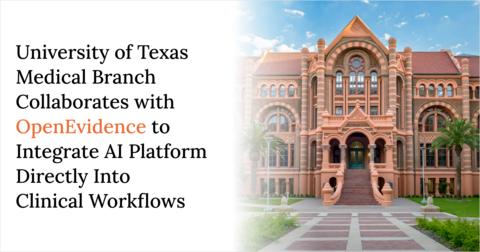
The integration, which went live at UTMB in March, was developed to provide clinicians access to AI-enabled information resources within existing clinical workflows.
OpenEvidence is embedded within UTMB’s electronic health record environment, and clinicians access the platform using their standard UTMB enterprise credentials. Rather than requiring clinicians to move between disconnected applications or establish separate accounts, the integration brings OpenEvidence within UTMB’s existing clinical workflow and enterprise security envelope.
Once authenticated, clinicians can ask clinical questions in natural language and receive responses that include citations to medical literature, clinical guidelines and other sources. The approach combines the accessibility of generative AI with the evidence orientation required for clinical decision-making.
Since the March launch, UTMB has seen strong growth in both the number of clinicians using OpenEvidence and the volume of clinical queries they submit. Today, more than half of UTMB clinicians actively use OpenEvidence for clinical decision support. Adoption data indicate that many clinicians have chosen to incorporate the tool into their workflow.
“Healthcare has no shortage of promising AI tools. The harder challenge is making those tools genuinely usable in clinical practice while maintaining the security, governance and trust that healthcare requires,” said Peter McCaffrey, MD, MS, FCAP, Vice President and Chief Digital and AI Officer at UTMB. “Our implementation of OpenEvidence provides clinicians access to AI-generated information that include citations to medical literature and guidelines. The growth in utilization since launch suggests that when you remove friction and put useful AI where clinicians actually work, they use it.”
The breadth of UTMB’s geographic footprint — with hospitals located on four campuses in addition to more than 100 clinics across Southeast Texas — makes rapid access to current medical knowledge particularly valuable: clinicians practicing across UTMB’s network can access the same evidence-based AI capabilities regardless of their physical location.
“UTMB has approached AI deployment with a clear understanding that successful clinical technology has to fit naturally into the way clinicians already work,” said Travis Zack, MD, PhD, Chief Medical Officer at OpenEvidence. “By integrating OpenEvidence into the clinical environment and simplifying secure access, UTMB is demonstrating how health systems can move evidence-based AI from an interesting technology to an everyday clinical capability.”
The OpenEvidence implementation is part of UTMB’s broader strategy to responsibly integrate AI into healthcare delivery. Rather than treating AI as a collection of standalone applications, UTMB is working to establish an enterprise environment in which validated AI capabilities can be securely incorporated into clinical and operational workflows, governed appropriately and evaluated based on their real-world use and impact.
For UTMB, the OpenEvidence deployment also represents an opportunity to understand how clinicians interact with a new generation of AI-enabled knowledge tools at scale. As adoption grows, UTMB will continue evaluating utilization, clinician experience and opportunities to improve how evidence and clinical intelligence are delivered at the point of care.
OpenEvidence is the most popular AI for doctors in the United States. According to independent studies, more American physicians use OpenEvidence than all other AI platforms combined. OpenEvidence is trusted by millions of verified U.S. healthcare professionals making high-stakes clinical decisions at the point of care, with evidence that is sourced, cited, and grounded in peer-reviewed medical literature. Founded with the mission to organize and expand the world’s collective medical knowledge, OpenEvidence is now used daily, on average, by the majority of physicians in the United States. OpenEvidence is free for all verified U.S. clinicians. Learn more at openevidence.com.
View source version on businesswire.com: https://www.businesswire.com/news/home/20260922367962/en/
Media gallery

